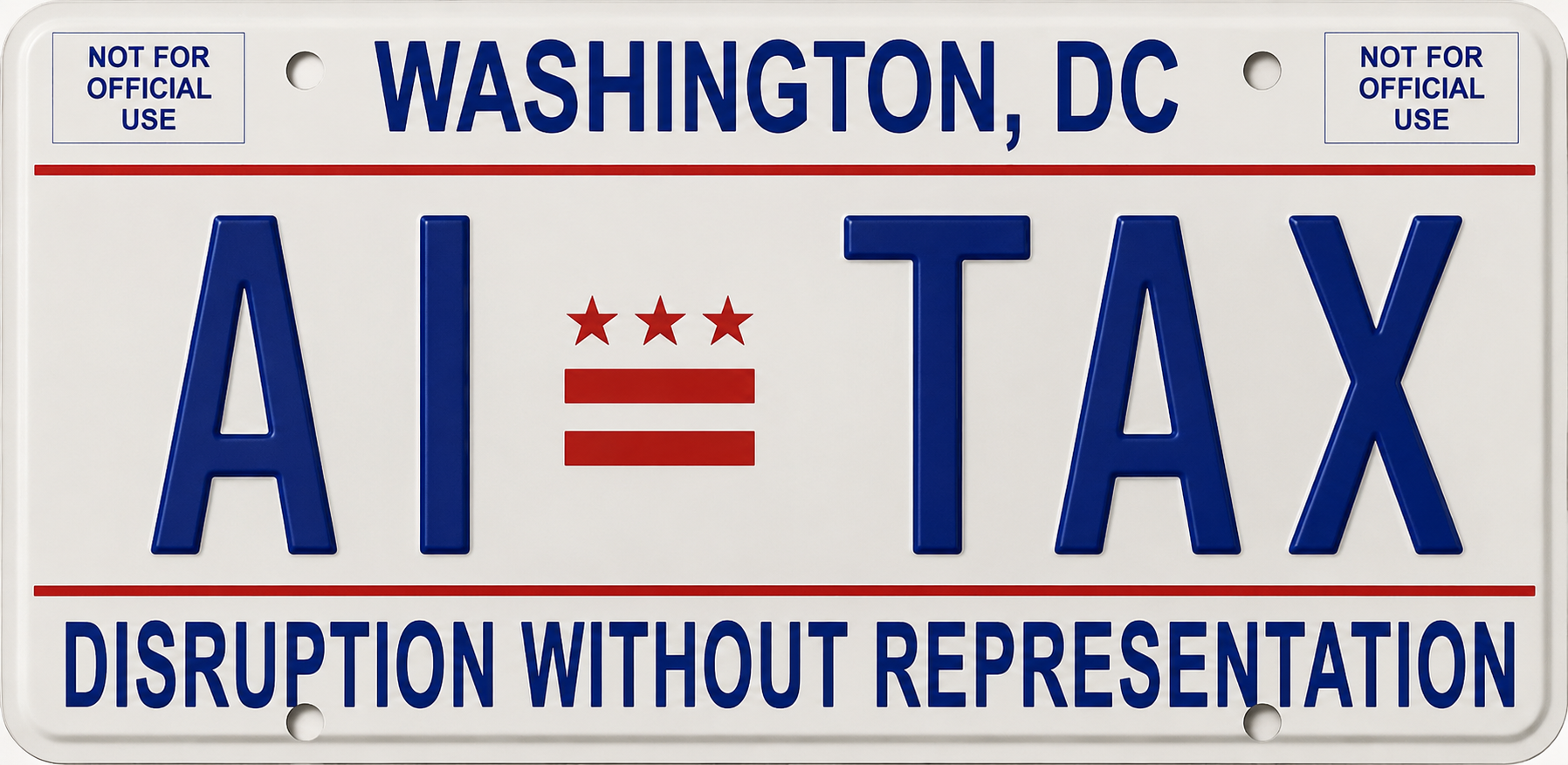
We Can't Afford to Wait: Why AI Upskilling Is Everyone's Urgency

Maria Montessori said more than a century ago: "An education capable of saving humanity is no small undertaking; it involves the spiritual development of man, the enhancement of his value as an individual, and the preparation of young people to understand the times in which they live."
As a Montessori mom, those words have shaped how Sandra thinks about learning and her children's development for years. Lately, though, this idea has been rattling around in both of our heads for a different reason. Because in a moment when artificial intelligence is remaking the tools we use to work, create, communicate, and organize — at a pace none of us have experienced before — the obligation to understand the times in which we live cannot be left to young people alone. It belongs to all of us.
That includes the professionals who have been in the workforce for five years, as well as the ones who've been in it for twenty. The ones who built careers around skills that were considered durable and are now, suddenly, not quite so certain. The ones who are good at their jobs and are watching the ground shift beneath them without any clear map of where solid footing is.
And at the same time, our children are already forging that path. For better or worse, with guidance and without it, they are using AI the way earlier generations used Google, asking questions, exploring ideas, figuring things out in real time. Sometimes cheating, but also sometimes learning. Sometimes taking shortcuts, but sometimes finding new pathways to understanding. They’re picking it up in school, from friends, and on their own. Which means the question isn’t whether they’ll use these tools; it’s how. And whether we, as adults, are engaged enough to help shape what “good” looks like.
Preparation cannot be left only to children and the young. It has to belong to all of us, not just as a matter of readiness, but as a matter of responsibility to one another. And it cannot wait.
A Disappointing Answer
We've been sitting in candidate forums lately — the kind where DC residents show up to hear who's running for Mayor and DC Council, and what they plan to do once they get there. We attend these forums because we care about this city and because we believe in civic life and its power to change things. And lately we’ve been going with a specific hope: to hear someone say something unexpected, or even just more complete, about one of the questions that matters most right now.
How will you ensure that people across this city—across income, race, age, and education—have fair access to the tools, skills, and judgment needed to navigate AI’s impact on our workforce?
We haven't heard a satisfying answer yet. When candidates respond, the answers tend to sound the same. Trade schools. Vocational pathways. These are not bad answers. But they are incomplete ones.
They focus almost entirely on people entering the workforce, while leaving out everyone already in it: early-career professionals, mid-career professionals, career changers, people with degrees and established skills who still have decades of work ahead of them, and people facing sudden disruption, including federal workers and others who have been laid off or pushed out and are trying to figure out what comes next. In a moment that requires all of us to adapt, the conversation remains narrowly framed around workforce entry, an answer that feels less like preparation and more like avoidance of the AI question itself.
But as we’ve been thinking, and as we see in our own lives, that’s not how this moment is unfolding. The need to understand and engage with AI is not limited to students or new participants in the workforce. It is already here for all of us. And it is already shaping how our children learn, explore, and make sense of the world, often in ways that outpace the adults around them. We cannot outsource this to the next generation. If anything, the speed and stakes of this moment create a moral obligation for adults to engage and to understand these tools, to guide how they are used, and to ensure that no one is left to navigate them alone.
We leave those forums frustrated. Not because the candidates are being dishonest, but because they are being unimaginative. And we do not have the luxury of unimaginative right now.
The Problem With Waiting
There is a particular kind of paralysis that sets in when something changes faster than our institutions can process it. It looks like a lot of careful watching. It looks like waiting to see what other cities do. It looks like task forces and listening sessions and waiting for reports to be written that are inadvertently enabling a critical moment to pass.
We understand the impulse. Nobody fully understands where AI is going. The technology is changing week to week. The experts disagree. Predictions range from transformative to catastrophic to somewhere in the middle that nobody can quite define.
But here is what we know from years of community organizing and civic work: the communities that wait to act until everything is clear are never the ones who shape what happens next. Waiting is not neutral. Waiting is itself a choice, and it tends to benefit those who already have the most resources to navigate uncertainty on their own.
And in a city like ours, those differences are already stark. Access to reliable internet is not universal. Access to stable, good-paying jobs is not evenly distributed. And access to transportation, often the bridge to those jobs, isn’t either. Time, training, and exposure to new tools are not shared equally. When a new layer of technology is introduced into that landscape without intention, it doesn’t level the playing field; it amplifies the gaps that already exist.
We are not writing with unqualified optimism. The risks of unmanaged and unregulated AI are real and need to be confronted head on: environmental impacts from energy-intensive systems, bias embedded in training data, opaque decisionmaking, job displacement, confidentiality and privacy concerns, and the potential for these tools to concentrate power rather than distribute it. Ignoring those risks doesn’t make them go away;it just ensures they are borne unevenly.
We are already seeing how this plays out. In the legal world, large firms and some companies are building their own AI tools—customized, secure, and increasingly powerful—while others rely on free or lower-quality options with fewer safeguards. Those with strong networks, training, or employer support have a clear advantage. Everyone else is left to figure it out on their own. The result is a widening gap in capability, confidence, and opportunity, growing by the day.
What We Actually Need
So what do we need right now? It’s not another report. Or another forum where the question gets asked and the answer circles back to trade schools.
What we need is a model — a repeatable, accessible, community-based model — for helping students, working professionals, and seasoned employees build real fluency with emerging technologies. Not a passive model where someone hands you a curriculum and sends you home. An active one, where you learn by doing, alongside peers who are figuring it out alongside you, grounded in real problems that matter to your community and your work.
We need something that can move fast, because the technology is moving fast. Something that doesn't require a new institution to be built from scratch in every city. Something that can live inside the institutions we already trust like our libraries, our civic spaces, our neighborhoods.
And it needs to be honest. Because there is a lot about AI that deserves skepticism, and any model that pretends otherwise is selling something. The concerns are real. The risks are real. The ways this technology can go wrong, or be used badly, or concentrate power further among those who already have it: those are real too. Engaging seriously with all of that is not the opposite of upskilling. It is part of it.
This Is Not Just About the Technology
We want to be careful not to make this sound simpler than it is. AI is much broader than people contemplate and it is embedded in the systems we use every day: predictive text in our emails, search results, recommendations, document drafting, customer service chat, hiring filters, and more. Understanding this moment requires not just awareness of these current uses, but attention to how these tools are evolving and where they are being proposed to go next.
AI upskilling is not just about learning to use a new tool. It is about developing the judgment to understand what the tools are and to use them well. It is about understanding what these tools do well, where they go wrong, and what questions you need to be asking, including the uncomfortable ones. It is about maintaining your own critical faculties in an environment that sometimes encourages you to outsource your thinking.
That kind of education — the kind Montessori was pointing toward — is about developing the whole person, not just delivering a skill. It is about building people who can engage with a rapidly changing world from a position of understanding and agency, rather than confusion and fear. DC residents deserve that. They deserve a community where they can figure this out together, with structure and support, and with enough honesty to acknowledge that none of us has it fully figured out.
We're writing from the perspective of people who have spent years believing that everyone — including people without formal technology training and credentials, without corner offices, without large budgets — can and do change things when they have the information, the community, and the structure to act.
We’ve seen it through open data, where residents build dashboards, create transparency, and hold systems accountable. We’ve seen it through community organizing—parents, students, and civic hackers building tools, mapping problems, showing up to hearings, and moving the needle on issues that were supposedly already solved. And we’ve seen it in how people learn and navigate transportation systems: through a mix of formal guidance and everyday use, learning by doing, sharing knowledge, mapping gaps, and advocating for improvements together.
The AI moment is not different in kind from other moments when the world changed faster than our institutions could keep up. What is different is the pace. We don't have the luxury of a long runway. We need to disrupt before we are disrupted.
This post is the first in a series. In the weeks ahead, we'll dig into the harder and more honest parts of this conversation, including the very real concerns about AI that deserve more than dismissal, the danger of going it alone in a landscape this complex, the risk of waiting to see what everyone else does before acting, and why the communities that figure this out together will fare better than those that don't. We'll keep coming back to The Upskilling Labs model as a through line, because we think it's one of the few responses to this moment that takes both the urgency and the complexity seriously.
The good news is that we don't have to do it alone. We never did.