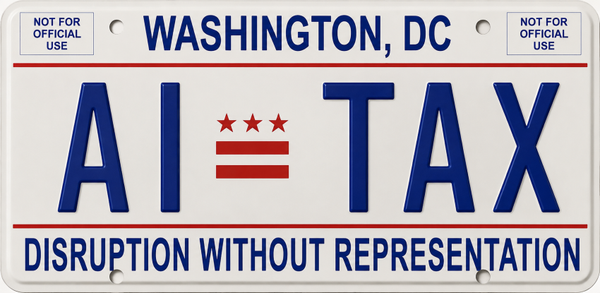
Remember When Uber Was Cheap?


A friend of mine, Greg Fuller sits on the board of a nonprofit. The staff are earnest and hardworking — the kind of people who chose this work because they genuinely care about the communities they serve, and who show up every day and do it well. When he visits the office, he told me recently, he feels he can see the future moving past them.
His worry isn't that the staff aren't capable. Like staff in many nonprofits, they are conversant in the use of AI, Greg says, “but that they're less equipped to freely experiment. And just as the big consulting firms band together as credible experts on and alongside the dominant AI tech companies, their first targets seem to be the large corporations, with bigger budgets, and margin to protect with calculated bets in AI. Some companies are launching new business units that are AI-native just as new startups emerge with fewer headcount by design.
Non-profits need trusted partners, technical assistance, and board-driven mandates to explore and invest. Albeit with the eye towards capturing near-term productivity gains and the understanding of the cost of both inaction and long-term dependence.”
Without space to experiment or community to experiment with, the gap between what AI makes possible and what many individuals (and small organizations) are positioned to access, is widening every month, quietly, without anyone declaring an emergency. The efficiency gains, the capacity to do more with the same number of people, the ability to synthesize information and surface patterns and generate first drafts of things that currently take hours — those benefits are real. And they are accruing to organizations like large corporations whose staff have the time, the budget, and the internal permission to experiment. Meanwhile, many of the people who could really benefit from exploring potential benefits are watching from the edge of the pool, as Greg says, waiting for a better moment to learn to swim, while everyone else is already in the water.
Ashwin Jaiprakash, an AI startup founder, said something recently to a group of individuals exploring AI that I really hadn’t put together… He said that for the general public, this is the cheapest AI is ever going to be. This is the time to learn how to apply it to things that matter.
Not a sales pitch. An observation about where we are on a curve that only moves one way.
And this reminds me of Uber.
In the early days of Uber, the rides were cheap. Deliberately, strategically cheap. The pricing wasn't a reflection of what the service actually cost to provide — it was a growth strategy. Get people hooked, reshape their habits and expectations, squeeze out the alternatives, establish the dependency, and then move the price to where it was always going to end up. Anyone who started relying on Uber because it was affordable and then watched the surge pricing climb over the years knows how that story goes.
AI is in that phase right now. The tools are accessible. The entry price is low. And that window — the period when you can experiment cheaply, make mistakes affordably, and build real fluency without a significant financial commitment — is not permanent. It's an introduction. A growth strategy. The cost curve on AI infrastructure goes one direction.
This is the time to learn and experiment.
AI is already being described as a future metered utility, like the internet.
The internet, however, is not a perfect analogy. Access to the internet is, in principle, free once you have a device and a connection. A scrappy organization or individual with limited resources can build something real on top of public infrastructure. AI doesn't work quite the same way. The underlying models are proprietary. The most capable tools are behind subscription paywalls that will, by most available evidence, look different in three years than they do today. Waiting for AI to be as freely accessible as a browser is probably waiting for something that isn't coming.
None of this means individuals or small organizations should abandon judgment and chase every new tool that surfaces. That's a different mistake. What it means is that deliberate, low-cost, peer-supported experimentation — learning by doing, on real problems, alongside people who are figuring it out at the same time — is not a luxury. It's the only practical response to a window that is, by most available evidence, closing.
Waiting for a better moment to get in the water is not prudence. It's how you end up watching from the edge while everyone else learns to swim.